
Mindful Shopping: Understanding Consumer Behavior in Online Retail
Online shopping platforms are engineered to remove the friction between impulse and purchase — and most people buy more than they intended.
My Role
UX Researcher
Methods
Scenario-based observation · Semi-structured interviews · Affinity diagramming · Persona development · User journey mapping
Tools
Zoom · FigJam · Mural · Notion · ATLAS.ti
The Problem
One-click checkout, countdown timers, "only 3 left in stock" warnings, and algorithmically tailored recommendations have systematically removed the friction between impulse and purchase. The psychological checkpoints that once gave people pause, like a trip to the store or waiting in line, have been engineered away.
The result is overconsumption, with real financial and environmental costs. But before anyone could design something to help people shop more intentionally, we needed to understand something more fundamental: what actually happens when young adults shop online? Not what they say they do, but what they do and why.
Research Question
What are the user needs in a technology designed to help young adults make more mindful online purchasing decisions?
This kept us in the research space intentionally. We wanted to understand the behavioral and psychological landscape well enough to identify what kinds of interventions might actually work and at what moments they would need to occur.
What We Did
Observation Study
Six participants completed a structured shopping scenario on Amazon and SHEIN while we observed in real time. Each participant was given a specific task: browsing for a type of item they'd realistically buy, to simulate a genuine shopping session rather than an artificial one. We tracked navigation patterns, how they responded to promotional cues like urgency messaging and discount badges, what drew their attention on product pages, and where they slowed down, hesitated, or moved through quickly without stopping.
The protocol was designed specifically to capture behavior that participants themselves might not consciously register or accurately describe later. We wanted to see what happened at the moment of decision, not a reconstruction of it.
Interviews
We followed up with six semi-structured interviews to get at the motivations and attitudes behind what we'd observed. Topics included typical shopping habits and platform preferences, how participants described their decision-making process, their feelings and relationship with spending, and past experiences of post-purchase regret or second-guessing. Where relevant, we used specific behaviors we'd observed as prompts, asking participants to explain what they were thinking in a moment we'd noticed during the observation.
Using both methods together was intentional. Observation shows what people actually do; interviews surface the reasoning, context, and feelings that explain it. The two methods check each other in ways that neither can alone.
Before moving into affinity diagramming, we coded the interview data, going through notes and responses to tag segments with descriptive labels capturing what was being said and why it mattered. We developed a codebook to document and define each code consistently, so the labeling stayed grounded and replicable across the full dataset rather than drifting as we went. That coding process gave us a structured layer of interpretation between the raw data and the thematic clustering, and made the affinity diagramming more deliberate rather than purely intuitive.
Key Findings
Our affinity diagramming surfaced three themes:
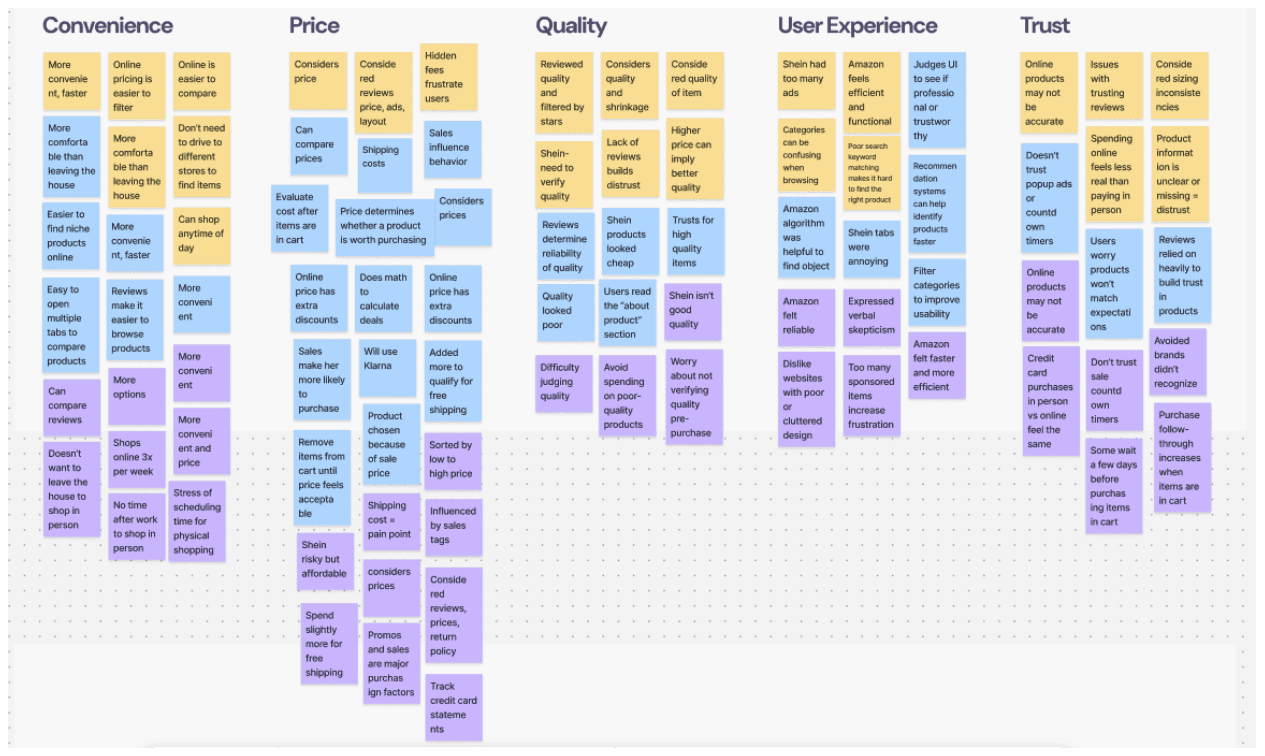
Platform-driven behavior
Much of what participants did was being shaped by the platforms, often without them realizing it. Amazon's frictionless checkout removed every natural pause before purchasing. Urgency cues like limited stock warnings, flash sale countdowns, "X people are viewing this," triggered an emotional response even when participants intellectually recognized them as marketing tactics.
Pricing and identity influence
Several participants described seeking the "best deal" as a goal in itself, separate from any actual need for the item. Finding a discount reframed the decision from "should I buy this?" to "can I afford not to at this price?" On SHEIN especially, purchases were also tied to identity and aesthetic aspiration which made them feel more meaningful and harder to second-guess.
Trust and quality perception
Participants had significantly different baseline trust toward Amazon versus SHEIN, and that trust shaped how much research they did before buying. Where trust was lower, social proof — reviews, photos, verified purchases — became the deciding factor.
We also developed four personas from the data. To complement them, we created persona spectrums, behavioral axes that mapped participants across relevant dimensions like planned versus spontaneous shopping and price-driven versus quality-driven decision making. The spectrums helped show that our personas weren't just discrete types but positions on a continuum, which made the design implications feel more grounded in the actual spread of behavior we observed. We then mapped user journeys for key shopping patterns, tracing the emotional and behavioral arc of a session end to end and annotating where mindfulness interventions could fit naturally into the flow.
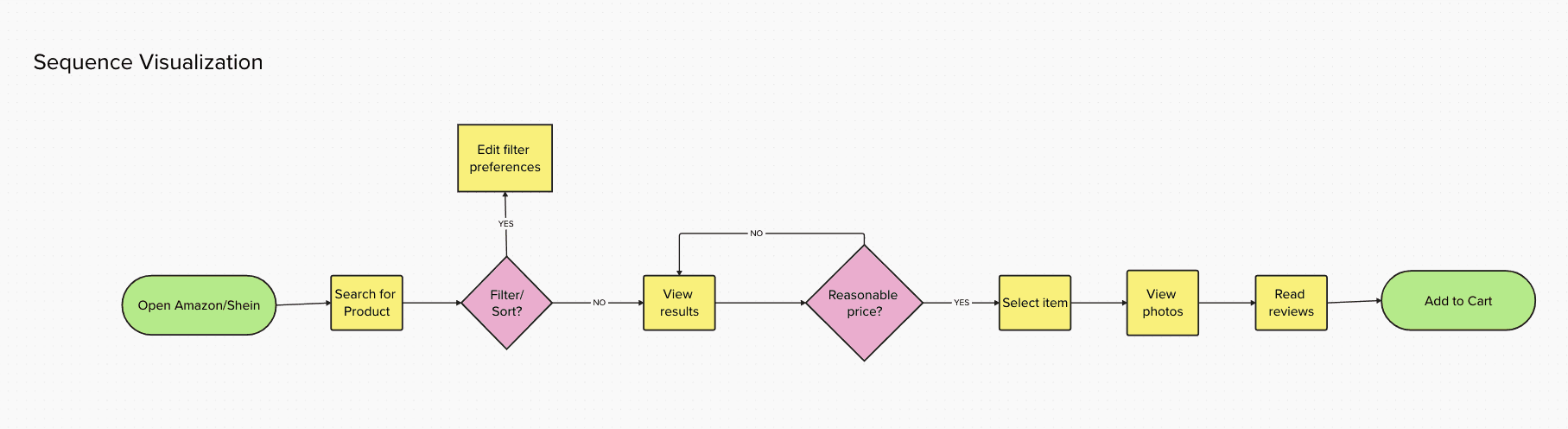
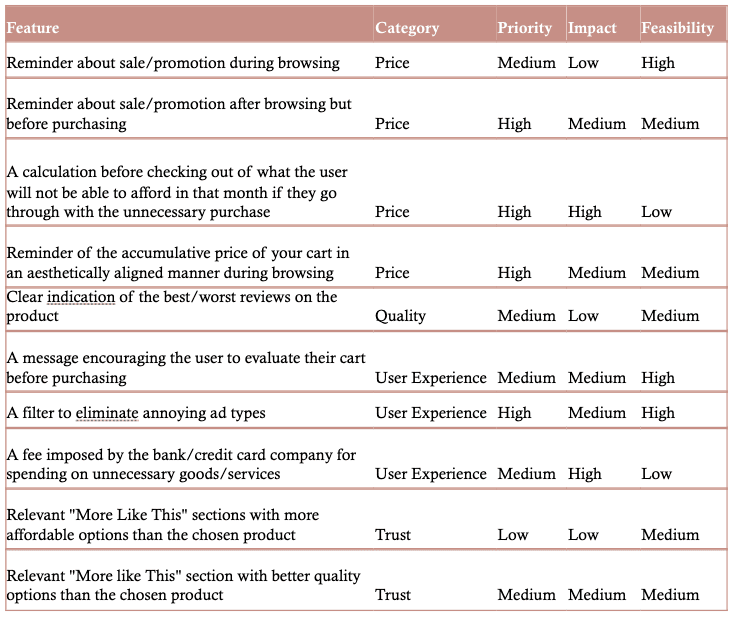
To move from findings to design directions, we used two synthesis tools. A sequence diagram mapped the step-by-step flow of a typical shopping session, marking the specific decision points where behavior shifted and where platform-driven cues had the most influence. A priority matrix then plotted identified user needs against their frequency and severity across participants, giving us a structured way to decide which problems were worth designing for first. Together, these artifacts made the path from research insight to design recommendation explicit rather than intuitive.
Design Implications
Three directions emerged as the most promising areas for intervention:
Checkpoints at incentivized moments
Because urgency cues consistently bypassed deliberate decision-making, a useful intervention would introduce a brief pause precisely when a discount or time-limited offer appears. The goal is to slow the user down at the exact moment the platform is trying to speed them up.
Reflection at the point of final purchase
A simple prompt at checkout: "Is this something you planned to buy, or something you discovered while browsing?" could interrupt the frictionless flow and invite self-reflection without blocking the purchase. Awareness, not prohibition.
Cumulative spending visibility
Participants rarely had a clear sense of how much they'd spent in a session. A persistent, low-key display of session spending, integrated into the interface rather than buried in account settings, could make the financial reality visible in a way that currently doesn't happen.
Deliverables
The final deliverables included an interview codebook, affinity diagram, sequence diagram, priority matrix, four personas with spectrums, design scenarios, and user journey maps.
Reflection
This project pushed me to think carefully about the relationship between research methods and research goals. Observation and interviews both produce qualitative data, but they access different kinds of knowledge. Observation captures what people do when they're not narrating their own behavior. Interviews surface the reasoning, feelings, and context that explain what you observed. Used together, they check each other.
What surprised me most was how self-aware participants were about the platform dynamics affecting them and how little that awareness protected them. Multiple participants recognized urgency cues as marketing tactics, acknowledged being manipulated to some degree, and still felt the emotional pull. That's a meaningful design insight: an intervention that simply informs users they're being nudged probably won't be enough. It needs to interrupt the emotional response before rational awareness can catch up.
If I were to extend this research, I would study the same participants longitudinally across multiple shopping sessions to understand whether mindfulness-oriented interventions actually change behavior over time, or whether users adapt to and ignore them. The real test of any design in this space is whether the effect sustains once the novelty wears off.